
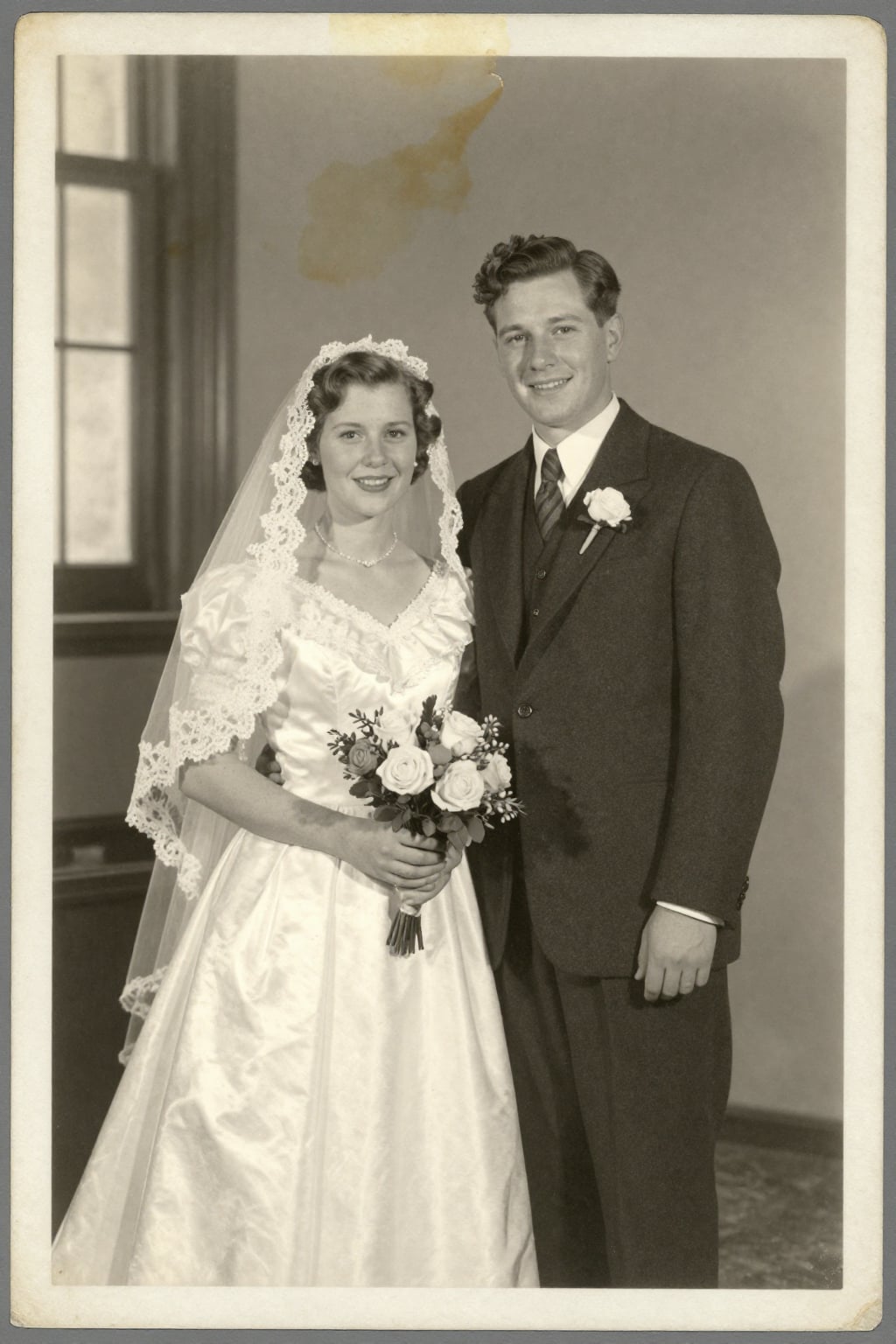
It's usually a shoebox. A burst pipe, a damp basement, one bad storm — and the box that held sixty years of a family comes out with the prints rippled, stuck together and ringed with brown tide lines. The first question we're asked is always the same: how much of it is gone? The honest answer: far less than it looks, and more than we'd like. This note explains which is which.
§ 01 · The chemistryWhat water actually does to a print
A photographic print is a sandwich: a paper base coated with a thin layer of gelatin — the emulsion — that carries the image. Gelatin is the same material as dessert jelly, and it behaves like it. In water it swells, softens, and turns adhesive, which is why wet prints weld themselves to each other and to album pages.
The brown tide lines come next. As the print dries, water migrates toward the edge of the wet patch, carrying dissolved minerals, paper acids and loosened dye with it, and deposits them in a ring at the drying front. And if the print stays damp past a day or two, mould arrives — it eats gelatin, and what mould eats no one recovers.
Black-and-white prints ride this out best: their image is metallic silver, locked in the gelatin. Colour prints are chemically dyed, and dyes dissolve — which is why a water-hit colour photo bleeds at the edges while a B&W one mostly just stains.
A tide line isn't a stain sitting on the photograph. It's part of the photograph, moved somewhere it shouldn't be.
§ 02 · TriageIf the photos are wet right now
- 01Move fast — you have roughly 48 hours before mould starts. Cold, moving air is your friend.
- 02If prints are muddy, rinse them gently in a tray of clean, cold water. Hold them by the edges; never rub or blot the image side.
- 03Air-dry them image-side up on paper towels, weighted at a corner if they curl. No hair dryers, no sunshine, no radiators.
- 04Don't peel stuck stacks apart dry — that takes the image with it. Soak the stack in cold water until the prints release on their own, or freeze it in wax paper and deal with it calmly later.
- 05The moment they're dry, scan everything — even the ones that look hopeless.
§ 03 · The spectrumHow much is recoverable
Water damage isn't one condition — it's a spectrum, and where a print sits on it decides what restoration can honestly promise.
- Fully recoverable — tide lines, staining, fading, foxing. The image density underneath survives; the damage sits over it like a dirty window. This is the large majority of water-damaged photos we see.
- Mostly recoverable — dye bleed and softened detail. The information is smeared, not erased. Restoration reconstructs edges from the surrounding tones — a jawline, a lapel, the line of a veil.
- Gone — flaked or lifted emulsion. Where the gelatin physically left the paper, there is nothing underneath to recover. Restoration can rebuild a missing collar or a patch of sky convincingly; a missing face is a portrait, not a recovery — and we'll always be straight with you about which is which.
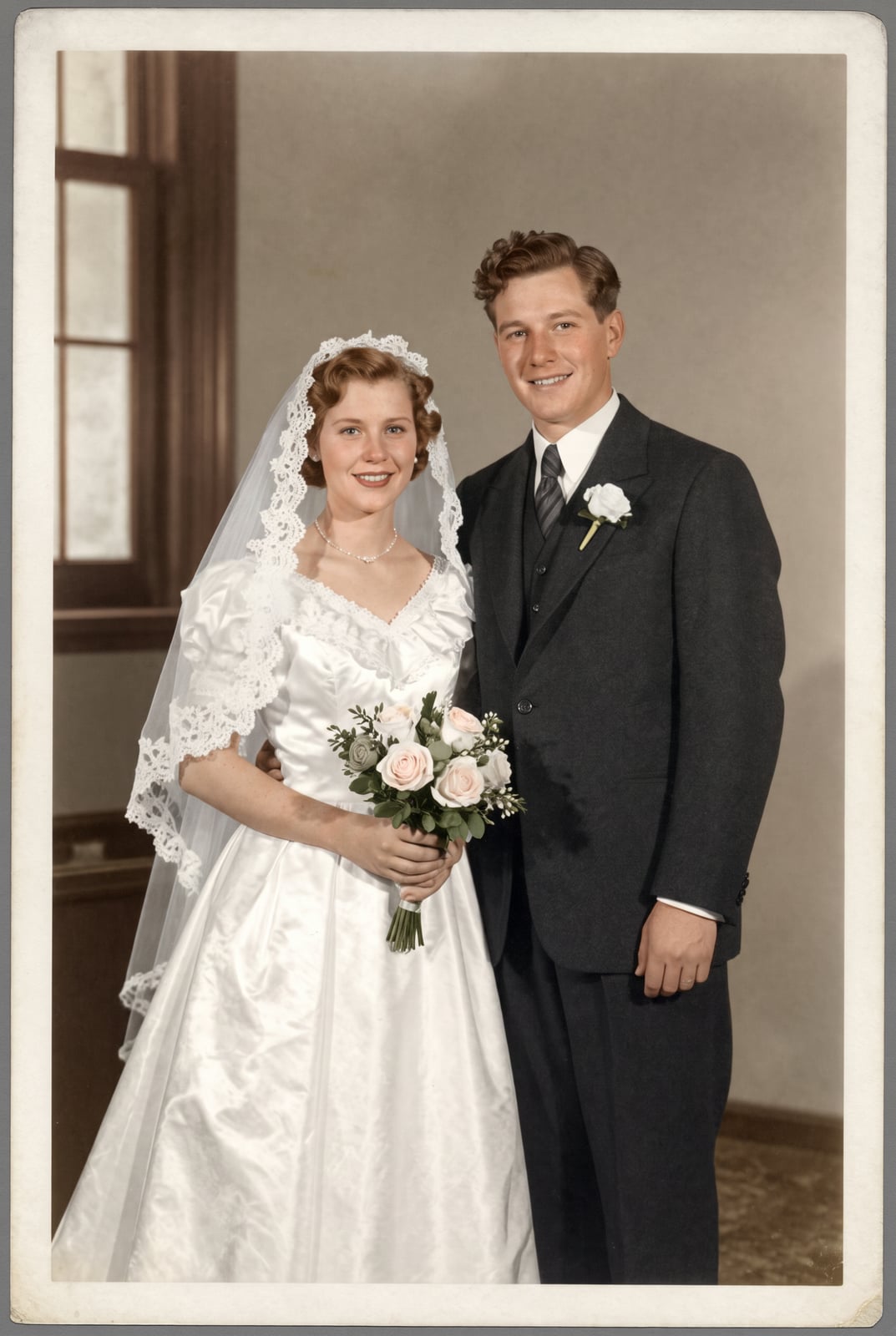
One more honesty note: reconstruction involves judgement, and judgement can miss. If a restoration guesses a coat's colour wrong or fumbles the lettering on a sign behind the couple, that's exactly what a Touch-up is for — you tell us what's wrong, we redo precisely that.
§ 04 · A second caseWater stains, ninety years on
Damage doesn't have to be fresh to be fixable. This 1930s graduation portrait spent decades with water staining across it — and because the staining sat above the silver image layer, the detail underneath waited intact the whole time.


§ 05 · Before you uploadGive the print its best shot
A water-damaged photo deserves an especially careful scan — the faint tones under a tide line are exactly what restoration digs detail out of, and a casual phone snap under ceiling light throws them away. We wrote up the full method in how to scan old photos at home. Then upload the scan — the first three restorations are free, so start with the print you're most worried about and see what's still in there.